
What are you looking for?

Vapor barrier plays a crucial role in the overall roof construction of flat roofs with EPDM. An incorrect, missing, or poorly installed vapor barrier can lead to condensation, moisture accumulation, and damage to both the roof covering and the underlying layers.
Because EPDM is relatively vapor-tight, vapor-related issues must always be resolved before installation, not after.
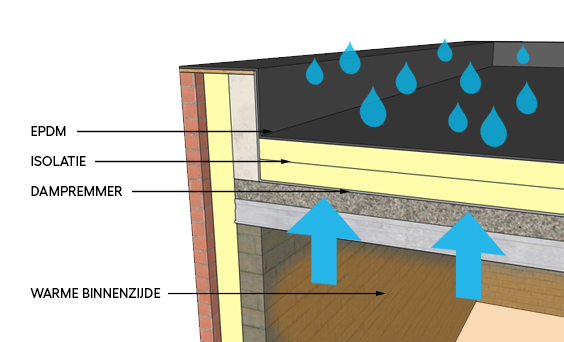
In a heated building, the indoor air always contains moisture. This warm, moist air naturally moves towards colder areas, in this case the roof. When this air cools down to below the dew point in the roof structure, the moisture condenses. A vapor barrier serves to control this humid indoor air and prevent condensation from forming in the insulation or under the roof covering.
This is particularly important for roof structures with EPDM. EPDM is relatively vapor-proof, which means that any moisture that enters the roof structure can hardly migrate to the outside. Without a proper vapor barrier, moisture can accumulate under the EPDM layer, resulting in reduced insulation value, deterioration of the adhesion, and, in the long term, damage to the roof structure. This risk is greatest in heated buildings such as homes, offices, and industrial halls.
A well-considered building physics structure takes temperature differences, indoor climate, and insulation thickness into account. The vapor barrier is not a separate element in this, but an integral part of the overall system.
In some cases, an incorrectly installed vapor barrier can be more harmful than no vapor barrier at all. If the vapor barrier is not installed airtight, is interrupted by penetrations, or is incorrectly positioned in the roof structure, moisture can still penetrate but cannot escape. This creates a trapped moisture situation that prevents natural drying.
This risk is particularly high in renovation projects, where existing roof layers are often unknown or incompletely documented. Old vapor barriers may be damaged, incorrectly positioned, or no longer compatible with the new insulation thickness. Blindly adding an extra vapor barrier without understanding the existing structure can lead to double vapor barrier layers, which actually increases the risk of condensation.
It is therefore strongly recommended that, if in doubt, a building physics calculation of the roof structure be carried out. Such a calculation provides insight into where condensation can occur and whether a vapor barrier is necessary, unnecessary, or even inadvisable. In renovation situations, a local incision in the roof can provide additional information about the existing structure and help to make a technically sound decision.
Proper vapor barrier installation under EPDM is not a minor detail, but a fundamental part of a sustainable roof structure. Errors in building physics are difficult to correct after the fact and often lead to damage that only becomes visible when extensive repairs are required.
By considering the indoor climate, the existing roof structure, and the position of the vapor barrier in advance, risks are limited and the long-term performance of the roof is guaranteed. Vapor barrier installation does not require a routine solution, but a technically sound choice.
No, this depends on the roof structure, the indoor climate, and the use of the building. Vapor barrier is usually necessary, especially in heated buildings.
Moisture can become trapped in the roof structure, leading to condensation, reduced insulation performance, and potential damage to bonding and construction.
Yes, because existing layers are often unknown. An incision can be made to examine the roof structure and determine whether an additional vapor barrier is needed. Based on the roof structure, a building physics calculation can then be made to arrive at the correct roof structure.
Yes, a double vapor barrier can trap moisture and actually increase condensation if the structure has not been calculated correctly.